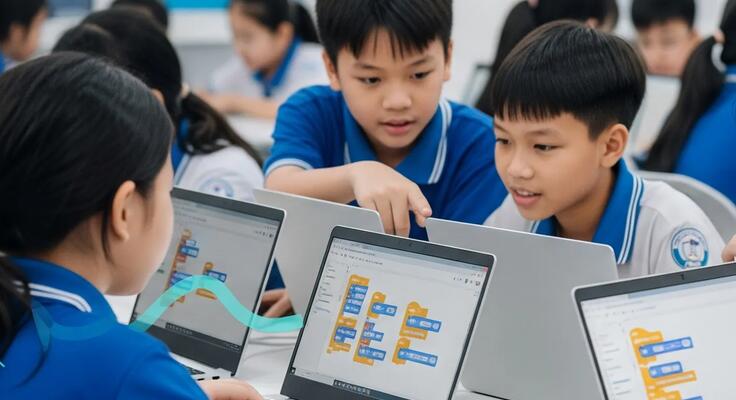
A new format of IT education for children in Ho Chi Minh City
At Swiss Coding Academy we have created a long-term educational system of a new generation - the Program of continuous IT-learning for children, developed by the methodologists of the school under the guidance of the founder of programming.school Sergey Shedov. Sergey has more than 25 years of experience in teaching IT skills.
The modern market of children's IT-education in Vietnam is saturated with short-term offers: three-month Scratch courses, summer intensives on game creation, one-time master classes. These formats give a child a first introduction to technology, but do not form what is really important - engineering thinking, systematicity, depth of understanding.
We have created something that the market lacks: a program that works like a music or art school. Each year adds a new layer of knowledge, each semester reinforces the previous one, each project builds confidence and skills. As a result, the child doesn't just "try programming" - he or she grows into an informed future engineer.
This is not a disjointed course, not a "programming class" and not a recreational activity, but a well-thought-out multi-year trajectory. In structure it resembles a music school: a child passes levels one after another, year after year increasing complexity and depth, forming a solid foundation and becoming more and more mature and self-confident future IT-specialist.
"Our goal is to raise not just a child who "took a course in Python", but a person who understands the principles of programming, can think algorithmically, is able to transfer knowledge between technologies and consciously choose the path of further development in IT." - Sergey Shedov, founder of programming.school

Sergey Shedov, Founder of programming.school
Who this program is for
The trajectory is designed for children from third grade and up. We have created three entry points, each of which takes into account the age, maturity and readiness of the child:
- Junior - for younger students who are taking their first steps in algorithmic thinking and programming.
- Middle Grade - for kids who are ready to move on to serious programming languages and engineering challenges.
- High Grade - for high school students who consciously choose a path in IT and are ready to study fundamental disciplines of computer science.
Within each level there is a division into groups of new students and continuing students. New students go through an adaptation module that levels them in the basics without slowing down the pace for those already in school.
This means your child can start at any age and receive a complete systemic education, not a disjointed set of skills.
.webp)
What makes our program unique
1. Project work is built into every lesson
In most schools, projects are separate activities: a "project holiday" every six months or a final paper at the end of the course. In our school, project work is the core of learning.
After studying each topic, children create or complete their own project. It can be an animation using loops and conditions, or a mobile application that solves a real problem. The main thing is the process: the child learns to formulate an idea, plan the realization, cope with difficulties, bring the work to completion and present the result.
Project-based learning gives something that test tasks do not:
- Deeper understanding - applying theory to practice solidifies knowledge forever
- Self-confidence - a completed project proves: "I can create, not just consume".
- Follow-throughskills - the ability to complete work, even if there are difficulties.
- Presentation skills - each project is defended in front of the group or parents.
2. Regular assessments and transparency of progress
Parents often hear from schools, "Your child is doing well, everything is good". But what exactly is "doing well"? What skills are being developed? Where are there difficulties?
At Swiss Coding Academy, we conduct regular assessments every semester. They include:
- Practical tasks - testing your understanding of the topics covered
- Project defense - assessing the quality of work and the ability to explain solutions
- Theoretical questions - to check understanding of concepts
Results are discussed with parents. You see not abstract assessments, but concrete skills: what exactly the child has mastered, how algorithmic thinking is developing, what to pay attention to.
This is the transparency that most educational programs on the market lack.
3. Connection to the real IT industry
Programming for kids shouldn't exist in a vacuum. It is important for children to see how their knowledge is applied in the real world, who works in IT, how a developer's life looks like.
Swiss Coding Academy is actively building partnerships with IT companies in Ho Chi Minh City and soon we will be organizing regularly:
- Tech Talks - meetings with engineers who talk about their projects and technologies.
- Mini-Hackathons - competitions where children solve problems in teams in conditions close to industrial ones.
- Excursions to IT-companies - visits to the offices of technology companies, familiarization with development processes.
- Project demonstrations - public presentations where children show their work to parents and industry representatives.
These activities give children context and motivation: programming is not an abstract school subject, but a tool for creating real products.
Why long-term learning is better than quick courses
Parents often want to see a quick result: that in a month the child will make a game or an app. This is an understandable desire, but it contradicts the nature of engineering education.
Real programming is not a set of tricks, but a way of thinking. Algorithmic thinking, the ability to break a complex task into simple steps, the habit of testing and improving code - all this is formed over years.
A child who studies for several years in a systems program gains not only skills in programming languages, but also an engineering culture: an understanding of how systems are organized, how to work with requirements, how to protect projects, how to find and fix bugs.
This approach requires patience, but it is the approach that produces sustainable results. Children who have completed the full cycle of training come out not with a set of certificates, but with real confidence in their abilities and an understanding of what they want to do next.
What our approach says about Swiss Coding Academy
The launch of this program is not just a new offering on the market. It is a statement of the school's position.
We don't chase fast money on short courses. We build long-term relationships with families and children. We have created a methodology that takes years to develop, our own educational platform, a system for evaluating progress, and partnerships with the industry.
Swiss Coding Academy under the leadership of Sergey Shedov relies on quality, systematic and fundamental. We want children who study with us to come out not just with programming skills, but with the readiness to become strong engineers.
What's next
The IT Continuing Education program is already open for enrollment. We are recruiting groups at all three levels: Junior, Middle Grade, and High Grade.
If you want your child to get not a short-term course, but a full-fledged systematic IT-education, which will become a foundation for a future career - we have created all conditions for this.
Swiss Coding Academy is located in Ho Chi Minh City, works with children from third grade and up, and is ready to be part of your child's educational journey for many years to come.
Welcome to a new era of children's IT education in Vietnam.